
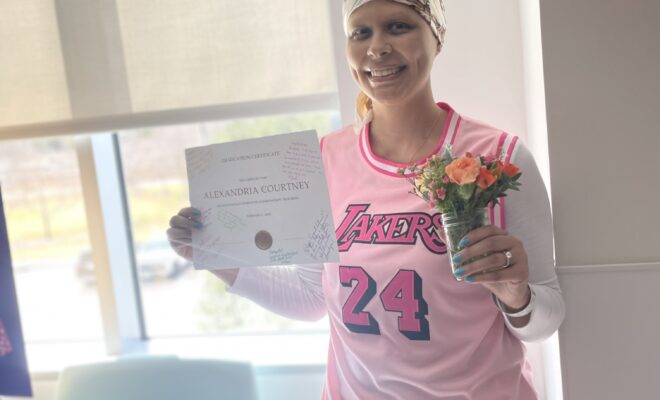
 Photo Credit: Houston Methodist Cypress Hospital
Health
Cypress nurse diagnosed with breast cancer at 34 urges young women to know the signs
For many women in their 20s and 30s, breast cancer can feel like a concern for later in life. But that is changing as diagnoses among women under 45 have risen about 1.5% annually since 2019, according to Dr. Dana Holwitt, breast surgeon at Houston Methodist Cypress Hospital and breast cancer survivor herself.

At 34, Alexandria Craig didn’t expect to be part of that trend. Six months after starting her job as an emergency department nurse at Houston Methodist Cypress Hospital, the young mother was diagnosed with stage 3 breast cancer and suddenly became a patient at the hospital where she cared for others.
“It was never something I expected at my age,” Craig said. “I had no family history of breast cancer, was focused on my career, raising my family and taking care of others. Suddenly, I was the one needing care.”
Surrounded by the care of her colleagues, Craig underwent 16 rounds of chemotherapy, surgery and 20 radiation treatments before achieving remission in June. She continued to work throughout her cancer journey and credits her team to help navigate her diagnosis and subsequent cancer treatment.
“Work provided an escape,” Craig said. “At work, I wasn’t the patient. I was someone who could still help. When I wasn’t able to continue caring for patients at the bedside, I was able to work as the unit secretary. Everyone met me where I was and supported me through every stage.”
Craig’s estrogen-positive tumor required hormone therapy to lower the risk of recurrence, triggering medically-induced menopause before age 35.
“At 34, I was suddenly navigating menopause while fighting cancer,” Craig said. “People think about chemotherapy, radiation and surgery, but hormone therapy can be just as challenging.”
Holwitt said her experience highlights a growing issue as more young women are undergoing treatment.
“More young women are surviving breast cancer, but survivorship comes with its own challenges,” Holwitt said. “Many are unaware of the long-term effects that can continue for years after treatment ends.”
Beyond hot flashes, treatment-related menopause can affect bone density, metabolism and weight management, Holwitt said.
“Maintaining bone health, metabolic health and a healthy weight can become lifelong priorities after treatment,” Holwitt said. “These changes are not always discussed enough, especially among younger patients.”
Nearly 1 in 8 women will be diagnosed with breast cancer in their lifetime according to the American Cancer Society. This Breast Cancer Awareness Month, Holwitt encourages women to perform regular breast self-exams starting around age 25, so they can recognize changes early and seek care when something doesn’t feel right.
HOW TO PERFORM A SELF-EXAM
- Always use the opposite hand to check each breast — so use the right hand on the left breast and the left hand on the right breast.
- Make your hand flat and use your fingers, from the middle knuckles to the fingertips, in a sweeping motion starting at the collarbone down toward the nipple with firm pressure.
- Sweep all the way around towards the nipple from the outside of the breast.
- Check the areola, the ring of pigmented skin around the nipple.
Holwitt recommends performing breast self-exams at the same time each month, ideally 5-10 days after the start of a menstrual cycle, while women without regular periods should choose a consistent monthly date. Although annual mammograms typically begin at 40, younger women should never ignore changes.
“We’re seeing more young women diagnosed than many people realize,” Holwitt said. “Knowing your family history, understanding what’s normal for your body and speaking up when something doesn’t feel right can make all the difference.”
For Craig, that message is personal.
“If sharing my story can encourage young women to pay attention to their bodies, ask questions or seek care sooner, it’s worth it,” she said. “You’re never too young to advocate for yourself.”
Houston Methodist offers 14 breast care centers across greater Houston and provides cancer treatment at all eight system hospitals. To schedule a mammogram, please visit houstonmethodist.org/mammogram.
Source: Houston Methodist