
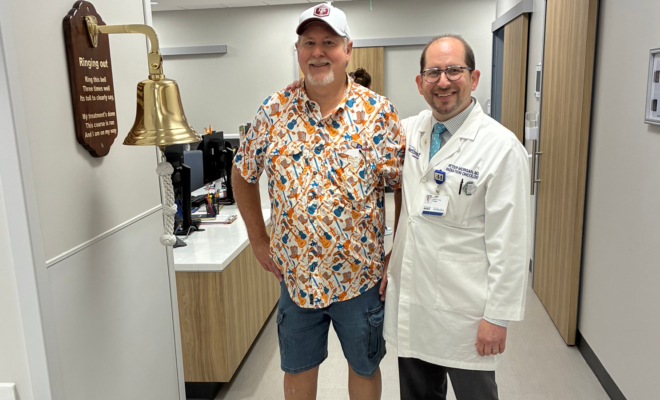
 Photo Credit: Houston Methodist Cypress Hospital
Health
‘For the next person in line’: Houston Methodist prostate cancer survivor crafts symbol of hope for future patients
Houston Methodist Cypress Hospital has quickly become a healthcare hub in northwest Houston, but some of its most meaningful stories are found beyond the exam rooms. Among them is prostate cancer survivor Barry Chautin, whose woodworking skills brought one of oncology’s most meaningful symbols, a celebration bell, to life.

While receiving treatment for aggressive prostate cancer, Chautin turned to woodworking as a therapeutic outlet. Inspired by his infusion team, he decided to use that outlet to handcraft wooden plaques featuring an inspirational poem for the hospital’s chemotherapy and radiation celebration bells, giving patients a meaningful way to mark the end of treatment and look ahead with hope.
“I wanted to do this for the next person in line, not just for me,” Chautin said.
Chautin’s cancer journey began with a routine checkup that revealed a sharp rise in his prostate-specific antigen (PSA) levels, leading to a referral to urologist Dr. Zachary Mucher at Houston Methodist Sugar Land Hospital. Initial testing showed what appeared to be a rare and aggressive form of stage 4 prostate cancer, delivering devastating news for Chautin and his family.
With support from his daughter, a nurse practitioner also at Houston Methodist Sugar Land Hospital, Chautin connected with a team of cancer specialists who quickly began treatment. They completed a procedure to remove cancerous tissue that was making it difficult for him to urinate and sent collected tissue for additional testing.
The latest biopsy revealed that Chautin had a more common but still aggressive form of prostate cancer, one with the potential for remission. With a long treatment journey ahead, the Hempstead resident elected to do chemotherapy and radiation closer to home at Houston Methodist Cypress Hospital.
“We as specialist physicians collaborate to develop individualized treatment plans for patient, and our goal is to cure,” Dr. Peter Morgan, radiation oncologist at Houston Methodist Cypress Hospital said. “In Barry’s case, his urologist, medical oncologist and radiation oncologist from both hospitals played a vital role in designing and delivering his treatment. My staff and I feel fortunate to know him, and to have had the honor in helping him beat his cancer.”
Following chemotherapy, surgery and nearly 40 rounds of radiation, Chautin entered remission. After he completed his final round of radiation, Chautin’s plaques were installed, and it was his turn to ring the celebration bell.
“You can’t control everything in life,” he said. “But you can control how you look at it.”
Like many patients facing a cancer diagnosis, Chautin was scared to begin treatment. Having heard about intense side effects, he wasn’t sure what to expect. During those early days, he leaned heavily on the support of his family and care team.
“The staff explained everything, treated me with kindness and were always checking on me – they truly went above and beyond,” Chautin said.
Now in remission, Chautin is encouraging other men to be proactive about their health and not put off screening conversations with their doctors.
“I tell all my friends to get checked,” he said. “I met people during treatment who were much younger than I was, and it really opened my eyes. Stay positive and trust your care team. They’ve got you, and they’re going to take care of you. Hakuna Matata.”
September is Prostate Cancer Awareness Month, and the American Cancer Society has found that nearly one in eight men will be diagnosed with prostate cancer during their lifetime. Houston Methodist oncologists urge men experiencing trouble starting or stopping urination, weak or interrupted urine flow, or painful and frequent urination to schedule an appointment with a urologist.
“A blood test known as PSA screening plays a vital role in helping detect potential prostate cancer before symptoms ever appear,” Morgan said. “Catching the disease in its earliest, localized stages makes active surveillance a safe alternative, closely monitoring slow-growing tumors through regular blood tests and imaging. When intervention is required, catching it early allows for targeted, lighter treatment options that minimize severe side effects and preserve overall quality of life.”
For more information about Houston Methodist, visit our newsroom.
Source: Houston Methodist Cypress Hospital